
Quadratic Functions
Introduction
|
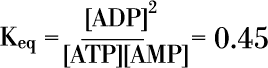
For example, a key enzyme in cells is adenylate kinase, which catalyzes the transfer of a phosphate group (PO4-) from adenosine triphosphate (ATP) to adenosine monophosphate (AMP). The result of this reaction is the formation of two molecules of adenosine diphosphate (ADP) by the following reaction, ATP + AMP ↔ 2 ADP. The equilibrium constant (Keq ) for this reaction is calculated as shown below:
where [ATP] is the concentration of ATP, [ADP] is the concentration of ADP, and [AMP] is the concentration of AMP. If you were given initial concentrations of ATP and AMP, could you calculate how much ADP you would have once the reaction reaches equilibrium? You can if you understand quadratic functions.
***** In the next section we explore the basics of quadratic functions. |
The Biology Project > Biomath > Quadratic Functions > Introduction
Department of Biochemistry and Molecular Biophysics
The University of Arizona
February 2006
Contact the Development Team
http://www.biology.arizona.edu
All contents copyright © 2006. All rights reserved.