
Transformations of Graphs
Horizontal Translations
|
What is a Horizontal Translation? Horizontally translating a graph is equivalent to shifting the base graph left or right in the direction of the x-axis. A graph is translated k units horizontally by moving each point on the graph k units horizontally.
The value of k determines the direction of the shift. Specifically,
Examples of Horizontal Translations Consider the following base functions,
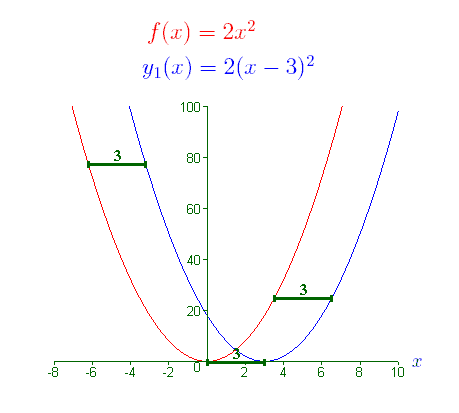
The graphical representation of function (1), f (x), is a parabola. What do you suppose the graph of y1(x) = f (x -3) looks like? Using the definition of f (x), we can write y1(x) as, y1 (x) = f (x-3) = 2(x -3)2 = 2(x2 - 6x + 9) = 2x2 -12x + 18. However, this expansion is not necessary if you understand graphical transformations. Based on the definition of horizontal shift, the graph of y1 (x) should look like the graph of f (x), shifted 3 units to the right. Take a look at the graphs of f (x) and y1(x).
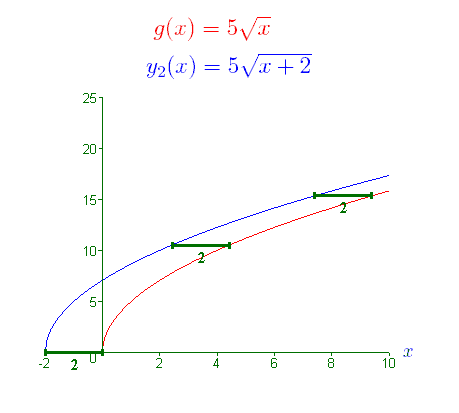
Function (2), g (x), is a square root function. What would the graph of y2(x) = g (x + 2) look like? Using our knowledge of horizontal shifts, the graph of y2 (x)should look like the base graph g (x) shifted 2 units to the left. We can write y2(x) as,
Take a look at the graphs of g(x) and y2(x).
***** In the next section, we will explore vertical stretches and shrinks. |

The Biology Project > Biomath > Transformations > Horizontal Translations
Department of Biochemistry and Molecular Biophysics
The University of Arizona
January 2006
Contact the Development Team
http://www.biology.arizona.edu
All contents copyright © 2006. All rights reserved.