
Mathematical Notation
Set-Builder and Interval Notations
|
Set-Builder Notation
{x | x ≠ 0}, is in set-builder notation. This set is read as, “The set of all real numbers x, such that x is not equal to 0,” (where the symbol | is read as such that). That is, this set contains all real numbers except zero.
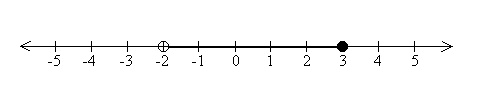
Another example of set-builder notation is, {x | − 2 < x ≤ 3} . This set is read as, “The set of all real numbers x, such that x is greater than −2 and less than or equal to 3.” As stated above, we can use set-builder notation to express the domain of a function. For example, the function
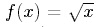
has domain that consists of all real numbers greater than or equal to zero, because the square root of a negative number is not a real number. We can write the domain of f(x) in set builder notation as, {x | x ≥ 0}. If the domain of a function is all real numbers (i.e. there are no restrictions on x), you can simply state the domain as, ‘all real numbers,’ or use the symbol Interval Notation We can also use interval notation to express the domain of a function. Interval notation uses the following symbols
Interval notation can be used to express a variety of different sets of numbers. Here are a few common examples.
***** In the next section we will describe summation notation. |
 to represent all real numbers.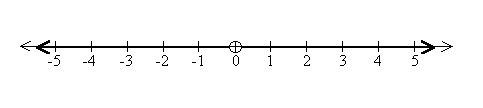
The Biology Project > Biomath > Notation > Set-Builder and Interval Notations
Department of Biochemistry and Molecular Biophysics
The University of Arizona
January 2006
Contact the Development Team
http://www.biology.arizona.edu
All contents copyright © 2006. All rights reserved.